


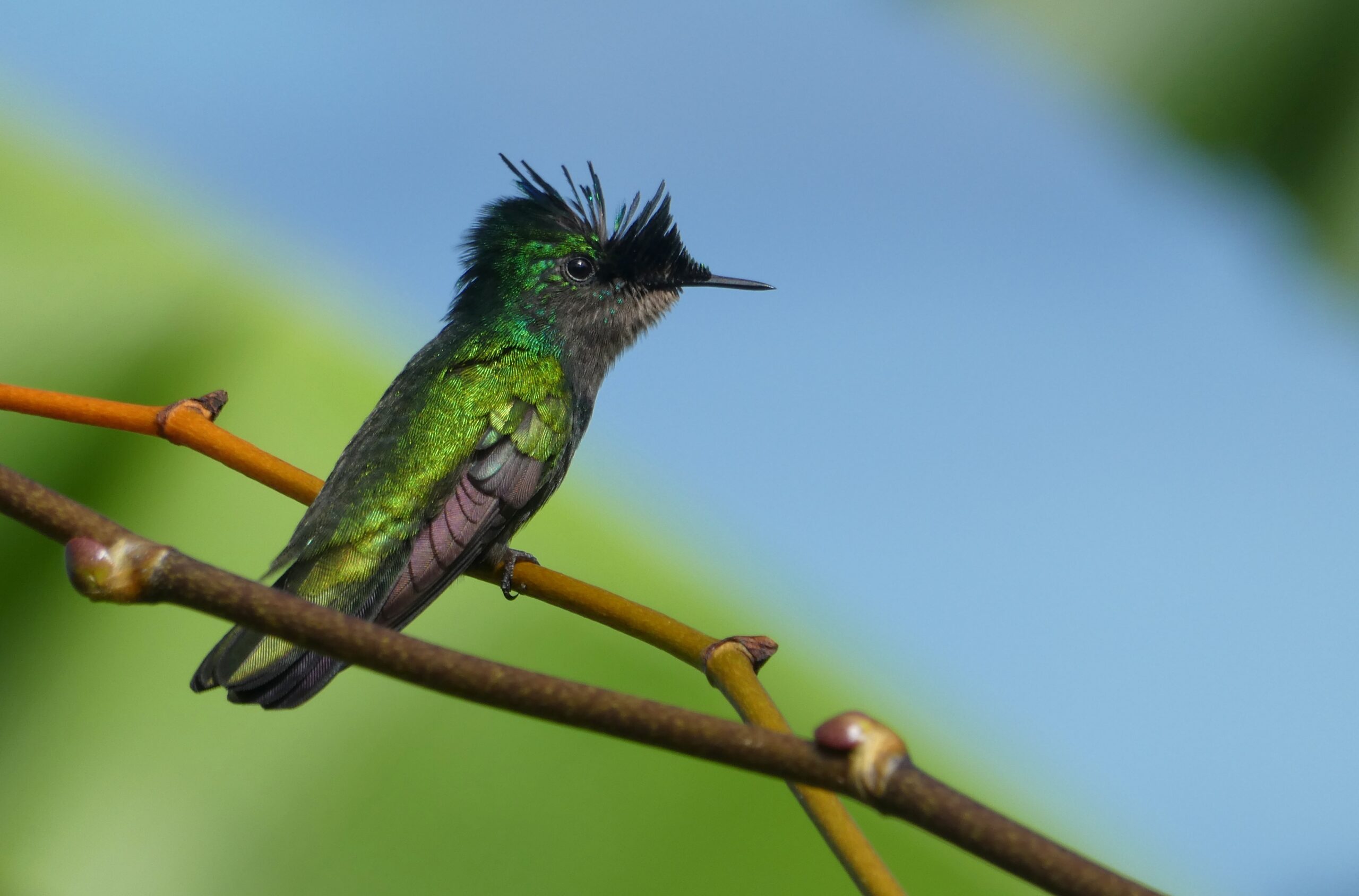
If birds had celebrities, hummingbirds would undoubtedly top the list. Birdwatchers travel thousands of miles for the chance to glimpse them, photographers spend hours waiting for the perfect shot, and even people with little interest in wildlife struggle not to stop and stare when one suddenly appears. Barely larger than an insect, they shimmer like living jewels, vanish in an instant, then reappear hovering effortlessly before a flower, wings beating so rapidly they dissolve into a blur. Few birds capture the imagination quite like hummingbirds.
Antigua & Barbuda’s national bird is, quite rightly, the magnificent frigatebird. With its enormous wingspan and the spectacular breeding colony found in Barbuda, it is one of the Caribbean’s great wildlife attractions. Yet for many visitors, it is the islands’ tiny hummingbirds that leave the most lasting impression. Whether darting through a rainforest clearing or hovering beside a hibiscus in a hotel garden, they hardly seem real.
Part of their appeal lies in the fact that hummingbirds are unlike any other birds on Earth. They are found only in the Americas, from Alaska in the north to the southern tip of South America, with around 365 recognised species spread across the New World. Over millions of years they evolved into one of nature’s most remarkable success stories, diversifying into an astonishing variety of sizes, colours and shapes while developing abilities found nowhere else in the bird world.
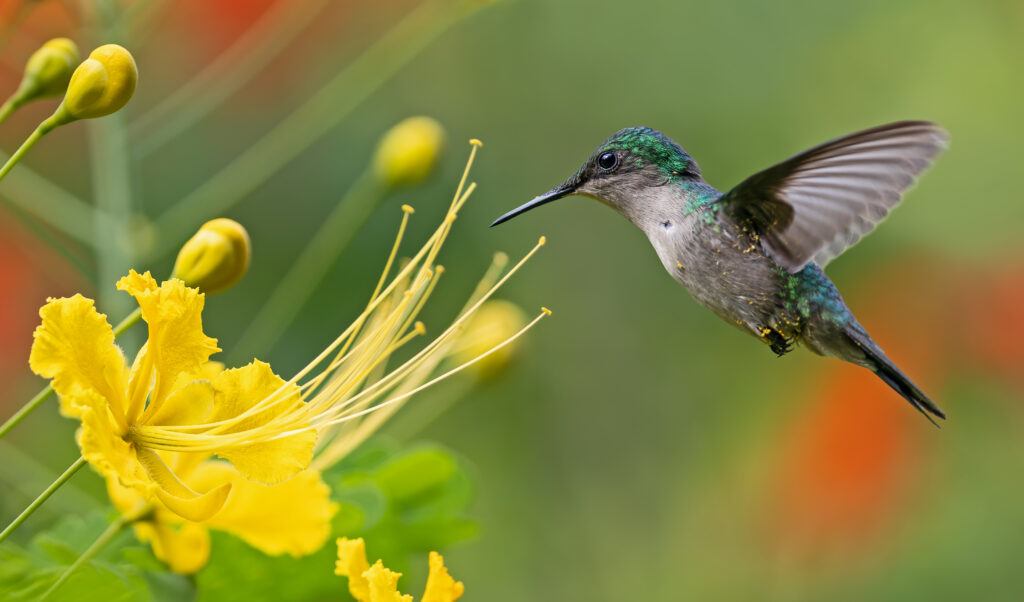
Their most famous talent is flight. Hummingbirds are the only birds capable of true hovering, remaining perfectly still in mid-air while feeding from flowers. They can also fly backwards, sideways and even upside down for brief moments, changing direction with breathtaking precision. Their wings beat at incredible speeds, often more than 50 times every second and, in some species, considerably faster. To the human eye they become almost invisible, producing the familiar humming sound from which they take their name.
Their most famous talent is flight. Hummingbirds are the only birds capable of true hovering, remaining perfectly still in mid-air while feeding from flowers.
Such extraordinary flight demands an extraordinary lifestyle. Hummingbirds have one of the fastest metabolisms of any animal, requiring an almost constant supply of energy. Nectar provides the fuel that powers their aerial acrobatics, while tiny insects and spiders supply the protein and nutrients needed to maintain their bodies. During a single day, a hummingbird may visit hundreds, sometimes thousands, of flowers, playing an equally important role as one of nature’s most effective pollinators. As they move from bloom to bloom, pollen is carried between plants, helping many tropical species reproduce. On a practical level, they also consume hundreds of tiny flying insects each day, including mosquitoes, helping to keep insect populations in balance.
Despite their tiny size, hummingbirds are surprisingly resilient. They have survived dramatic environmental changes over millions of years and today occupy habitats ranging from deserts and mountain cloud forests to tropical islands like Antigua & Barbuda. Their adaptability has allowed them to flourish across two continents, yet they still depend on healthy habitats filled with flowering plants.
However, while many hummingbird species remain common, not all are thriving. Scientists have recorded declining populations across much of the hummingbird family as forests are cleared, native vegetation disappears and changing weather patterns alter the delicate relationship between flowers and the birds that depend on them. The widespread use of pesticides, including mosquito control measures such as fogging, can also have unintended consequences. By affecting non-target insects, this can reduce an important source of protein for hummingbirds and increase the risk of exposure to harmful chemicals for birds and other wildlife. Protecting hummingbirds is therefore about far more than saving a beautiful bird. It means safeguarding the habitats and healthy ecosystems on which countless other species also depend.
For Antigua & Barbuda, hummingbirds are among the most delightful ambassadors of the islands’ natural heritage.
For Antigua & Barbuda, hummingbirds are among the most delightful ambassadors of the islands’ natural heritage. Three species are regularly found here, each with its own distinctive character.
Perhaps the easiest to recognise is the Antillean Crested Hummingbird. Small even by hummingbird standards, the male is unmistakable thanks to the dramatic emerald-green crest that crowns his head, catching the sunlight as he darts between flowers. It is a bird that seems almost designed to stop people in their tracks.
The Green-throated Carib is larger and equally impressive, its shimmering green plumage and gently curved bill making it a familiar sight in gardens and woodland edges across Antigua. Less commonly encountered is the Purple-throated Carib, a species that tends to favour the island’s lusher, more forested areas, rewarding patient observers with flashes of deep iridescent colour.
One of the pleasures of visiting Antigua & Barbuda is that you do not have to venture deep into the rainforest to see these remarkable birds. They are frequent visitors to flowering gardens, nature trails and even resort grounds where nectar-rich plants provide a reliable food source. Places such as Fig Tree Drive and Christian Valley are particularly rewarding for birdwatchers, while many coastal gardens around the island regularly attract hummingbirds throughout the day. You often don’t have to look for long. A hummingbird can appear in an instant, hovering beside a flower before disappearing just as quickly.
Hummingbirds often catch the eye of visitors who have never given birdwatching much thought, and it’s easy to see why people stop to watch them.
Hummingbirds often catch the eye of visitors who have never given birdwatching much thought, and it’s easy to see why people stop to watch them. They may weigh only a few grams, but their energy, beauty and astonishing agility leave an impression far greater than their size would suggest.
Conserving hummingbirds is about far more than protecting a single group of birds. It means preserving the flowering trees, shrubs and forests that support countless other species and keep ecosystems healthy. Every native plant that blooms, every garden filled with nectar-rich flowers and every patch of natural habitat helps ensure that these tiny aerial marvels continue to thrive, not only for their own sake, but for the health of the wider environment they help sustain.
In a country celebrated for its beaches and turquoise waters, it is easy to overlook the wildlife that shares these islands. Yet it is often the hummingbirds that visitors remember most. They may only appear for a few seconds, but once you’ve seen one glittering in the sunlight, you never forget it.
- About 365 hummingbird species are found only in North, Central and South America.
- They are the only birds capable of true hovering, remaining perfectly still in mid-air while feeding.
- Their wings can beat up to 200 times per second during courtship dives and around 50 times per second in normal flight.
- A hummingbird can visit up to 1,000 flowers in a day, carrying pollen from one bloom to the next.
- In addition to drinking nectar, hummingbirds eat tiny insects and spiders for protein.
- Hummingbirds remember which flowers they have visited, how much nectar each contains, and even how long it takes to refill.
- At night, they enter “torpor”, slowing their heart rate and conserving energy until sunrise.
- A hummingbird’s eggs are about the size of a coffee bean and weigh less than one gram.
- Some hummingbirds can reach speeds of up to 60 mph (97 km/h) during spectacular aerial dives.
- Antigua & Barbuda is home to three species: the Antillean Crested Hummingbird, the Green-throated Carib and the Purple-throated Carib.
- Habitat loss threatens hummingbirds. Planting native flowering plants can help support them.